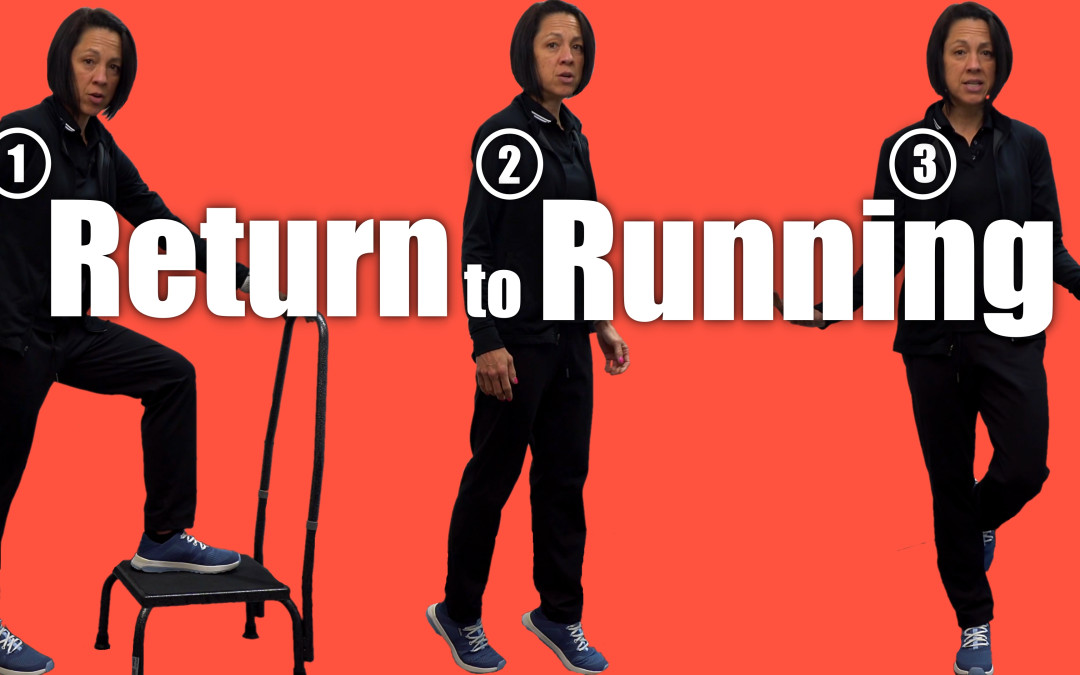
If you’ve had a neurologic injury and your goal is to eventually return to running, rebuilding strength and balance is only part of the process.
Running also requires your muscles to produce quick, coordinated movements through your hip, knee, and ankle.
This is where plyometric exercises and bounding exercises can become an important part of later-stage recovery.
What Are Plyometric Exercises?
Plyometric exercises involve a muscle lengthening and then rapidly contracting, allowing it to store and release energy much like a rubber band.
This is different from simply working on strength or power.
When you’re trying to return to jogging or running after a neurologic injury, you may notice an awkward, jerky, or unfamiliar sensation when your leg needs to quickly load and push off.
Plyometric training helps you practice this specific component of movement.
Are Plyometric Exercises Right for You?
Plyometric exercises are designed for the more advanced stages of neurologic recovery.
The progression in this video is intended for people who can:
- Stand on one leg for at least 5 seconds without holding onto anything
- Walk without an assistive device
- Have not had a fall within the last year
- Have a goal of eventually returning to running
If you aren’t at this level yet, that’s okay. You may need to work through earlier strength, balance, walking, and coordination progressions before beginning plyometric training.
Why Plyometric Training Matters for Returning to Running
Running requires your hip, knee, and ankle to work together quickly.
After a neurologic injury, you may have developed movement patterns that make it difficult to coordinate these joints or generate quick propulsion through the affected leg.
Plyometric training focuses on the ability to:
- Load the muscles
- Quickly transition from lengthening to contraction
- Push off the ground
- Control the landing
- Coordinate both legs
- Gradually increase the speed of movement
The goal isn’t simply to jump higher.
It’s to develop quick, coordinated propulsion that can eventually translate into more dynamic activities such as running.
A Plyometric Progression for Neurologic Recovery
The exercises in this progression build on one another. You don’t need to start with jumping or single-leg bounding.
Step 1: Hip, Knee, and Ankle Coordination
The progression begins with basic coordination.
You first practice bringing the hip, knee, and ankle together through a controlled movement before adding a true plyometric component.
Step 2: Assisted Coordination
The next step increases the movement while allowing the other leg to provide some assistance.
This helps you become more comfortable coordinating the involved leg without requiring it to perform everything independently.
Step 3: Assisted Foot Switching
The progression then becomes more dynamic.
You begin practicing switching the position of your feet, introducing the sensation of getting both feet off the ground and landing with control.
Step 4: Two-Foot Bouncing
Next, you progress to bouncing with your feet together.
The focus is on getting both feet off the ground at the same time and becoming comfortable with repeated loading and unloading.
Step 5: Side-to-Side Movement
Once two-foot bouncing is controlled, the progression introduces side-to-side movement.
This adds another challenge to lower-extremity coordination while gradually decreasing the time between loading and propulsion.
Step 6: Forward-and-Backward Movement
The next progression challenges your coordination in the forward and backward directions.
This continues preparing your muscles for quicker, more dynamic movements.
Step 7: Staggered-Foot Bounding
Now you begin working more directly on the bounding component of plyometric movement.
The feet are staggered, and the focus shifts toward quick propulsion while maintaining control and avoiding excessive weight shift onto the uninvolved leg.
Step 8: Single-Leg Bounding
Single-leg bounding is the most advanced progression discussed in the video.
This should come after you have developed good control with the previous staggered-foot exercises and can switch between sides effectively.
The goal is to eventually develop the quick propulsion and control required for higher-level activities such as running.
A Common Challenge After Neurologic Injury: Relying on Your Stronger Leg
One of the biggest things to watch during this progression is weight shifting.
After a neurologic injury, it’s common to naturally rely more on the uninvolved or stronger leg.
As the exercises become more dynamic, this compensation can become even more noticeable.
The goal is not to force your involved leg to do more than it can safely handle.
Instead, the progression is designed to gradually improve your ability to coordinate and load both legs while maintaining control.
You Don’t Have to Jump High
One of the most important concepts in this progression is that height isn’t the goal.
Plyometric training is about the rapid transition between loading and contraction.
That means a small, controlled bounce can be more appropriate than trying to jump as high as possible.
As your coordination and control improve, the challenge can gradually increase.
What’s the Next Step?
If you’re working toward running after a neurologic injury, having the right progression can make a significant difference.
The exercises shown here move from basic coordination to assisted dynamic movements, two-foot bouncing, directional movements, staggered bounding, and eventually single-leg bounding.
But knowing which exercise comes next—and how to perform and progress each one—can be challenging to figure out on your own.
Want More Guidance Between Physical Therapy Sessions?
Visit rehab-hq.com to learn more about the membership options or schedule a discovery call to determine which option may be right for you.
Articles you may be interested in

Stroke Rehabilitation Exercises: Why Specificity Matters for Better Walking
https://www.youtube.com/watch?v=rCRXccCHwIk Why Aren’t My Rehabilitation Exercises Improving My Walking? You show up. You do your exercises. You follow your routine. Yet walking still feels difficult, your foot catches on the floor, or you struggle to move your...

Doing Rehab Exercises Every Day but Not Improving? Your Program May Need a Reset
https://www.youtube.com/watch?v=08fvaKO6EKo Have you been doing your rehabilitation exercises every day but feel like you're no longer making progress? You may have a long list of exercises, yet your walking, foot clearance, or everyday mobility doesn't seem to...
Does Stroke Recovery Ever End? How to Improve Walking Years After a Stroke
https://www.youtube.com/watch?v=EkgoxFfroX4 If you have had a stroke, you may wonder how long recovery will take. Will you walk normally again? Is it still worth doing exercises years after your stroke? And how do you know when you have reached your full...

Why Pain and Nutrition Matter for Spasticity After Stroke
https://www.youtube.com/watch?v=_EdQGkOx4kw Have you ever woken up one morning feeling like your affected leg is moving a little more easily, only to find that the next day your ankle feels stiff, your foot wants to point downward, or your arm feels tighter...

Why Is Spasticity Worse Some Days? 3 Factors That Can Affect Spasticity After Stroke
https://www.youtube.com/watch?v=iBcU4c8kiqc If you live with spasticity after a stroke or other neurologic injury, you may have noticed something frustrating: Some days your muscles feel relatively loose and manageable. Other days, they seem much tighter. Your...

Spasticity Treatment After Stroke: Why Stretching Alone Isn’t Enough
https://www.youtube.com/watch?v=Vw8Y55f-sLY If you experience muscle stiffness, involuntary contractions, or difficulty moving your arm or leg after a stroke or neurologic injury, you've probably been told to stretch. But what if stretching alone isn't enough?...

Spasticity After Stroke: Why Your Muscles Feel Stiff
https://www.youtube.com/watch?v=mvDk3dMmc6E Muscle stiffness is one of the most common movement problems after a stroke or neurologic injury. Your arm may want to stay bent, your knee may feel stiff when walking, or your ankle and foot may constantly point...

Red Light Therapy After Stroke: Can It Help Support Brain Recovery?
https://www.youtube.com/watch?v=BFJzu1f2jEE Recovering after a stroke involves more than rebuilding strength or practicing movements. The brain itself is going through changes that can affect energy production, inflammation, blood flow, and its ability to form...

How to Improve Backward Stepping After a Stroke or Neurologic Injury
https://www.youtube.com/watch?v=FdYMY6Xj1fM Walking forward gets most of the attention in neurologic rehabilitation. But there is another movement that can have a major impact on your balance, confidence, and independence: Stepping backward. Think about how...

Stroke Recovery Treatments: How to Tell What May Actually Help
https://www.youtube.com/watch?v=nZWj2vVtDfw After a stroke or neurologic injury, it’s natural to look for anything that might improve recovery. Supplements. Devices. Electrical stimulation. New procedures. Hyperbaric oxygen therapy. Products promising to...


